Most CX programmes improve experiences without changing what customers do. Elemental CX starts by diagnosing why customers choose you, stay or leave, then focuses your strategy and investment on the experiences that change that behaviour.
Most CX investment fails to grow the business because it starts in the wrong place. Organisations map journeys, measure satisfaction and fix friction. The work is often well run, but it is not aimed at what causes customers to choose, which is why so many CX programmes produce better experiences that don't move the growth numbers. Journey mapping tells you what customers experience. It doesn't tell you why they chose you, why they leave, or why others never consider you at all. Elemental CX starts with those questions, so every improvement is aimed at the parts of the experience that change customer behaviour.
About Elemental CX
What is Elemental CX?
Elemental CX is our approach to customer experience. It starts by diagnosing the causal drivers of customer choice, then focuses CX strategy, design and measurement on those drivers. It is grounded in Clayton Christensen's Jobs to Be Done. Customers don't buy products or services because of what they are. They hire them to make progress in a particular situation. We identify the functional, emotional and social dimensions of that progress, and the forces that decide whether customers choose you, stay with you or leave.
The forces behind every choice
Four forces shape whether a customer switches to something new or stays with what they have:
Push: frustrations with the current situation that make customers look for something better.
Pull: the appeal of a new solution and the progress it promises.
Anxiety: concerns about the new solution that hold customers back.
Habit: the comfort of the current way of doing things.
Customers switch when push and pull outweigh anxiety and habit. Knowing how strong each force is in your market shows where the experience needs to do more work, whether that is strengthening the pull of your offer or reducing the anxiety that stops people from moving.
What we do
Customer choice diagnostic
Structured Jobs to Be Done research with your customers, prospects and lapsed customers. We identify the progress they are trying to make and the forces that decide whether they choose you, stay or leave. You get a clear, evidence-based view of what drives choice in your market.
CX strategy
Using the diagnosis, we set your CX vision, customer segments, experience principles and future state. We then build a prioritised roadmap that focuses effort on the experiences most likely to change behaviour. Journey maps and service blueprints follow from this work rather than leading it.
CX measurement
Satisfaction scores and NPS track sentiment, but they can’t tell you what to change. We put in place measurement frameworks that track performance against the drivers of choice, so you can see whether your CX investment is moving the things that matter.
Growth & innovation
Understanding customer choice also shows where new value can be created and captured. We help leadership teams find growth opportunities, test new propositions before committing investment, and build the capability to keep doing it.
How we work
1
Diagnose what drives choice
We start with a structured diagnosis of your customers' Jobs to Be Done: the progress they are trying to make and the forces that decide whether they choose you, stay or leave.
2
Build the CX architecture
We set the vision, customer segments, experience principles and future state. Journey maps and service blueprints follow from this.
3
Plan your CX effort
We build a prioritised roadmap, with every initiative tied back to the drivers of choice identified in the diagnosis.
4
Test new initiatives
We prototype and test new ideas with customers using Lean Startup methods, before investment is committed at scale.
5
Deliver experiences
Our Experience Design and Engineering teams, or your own delivery teams, design and build the experiences so the intent holds through to launch.
6
Measure and refine
We track performance against the drivers of choice and use the results to guide ongoing improvement.
Take the Elemental CX Diagnostic
How well is your CX programme positioned for growth?
Twenty statements give you an honest assessment of your CX capability, its role in growth and how well you understand what drives customer choice. Your results appear on screen straight away, with recommendations for where to focus next.
Our approach is grounded in a small set of established academic and strategic frameworks. Jobs to Be Done, developed by Clayton Christensen, is our primary lens for understanding customer choice: why customers hire, stay with, or fire a business. The Four Forces of Progress, developed by Bob Moesta alongside Christensen, explains the competing forces that determine whether customers switch. Good Strategy, as articulated by Richard Rumelt, shapes how we structure recommendations and roadmaps. And Lean Startup informs how we prototype and test new initiatives before committing investment at scale.
These are not references we drop into proposals. They are the thinking that sits underneath every diagnosis, every experience design decision, and every prioritisation call we make.
Our tools
Purple Shirt has developed two purpose-built tools that support the work. Our Customer Journey Mapping application is a web-based platform that enables clients to map, manage, and maintain their customer journeys in one place, keeping the work live rather than locked in a document.
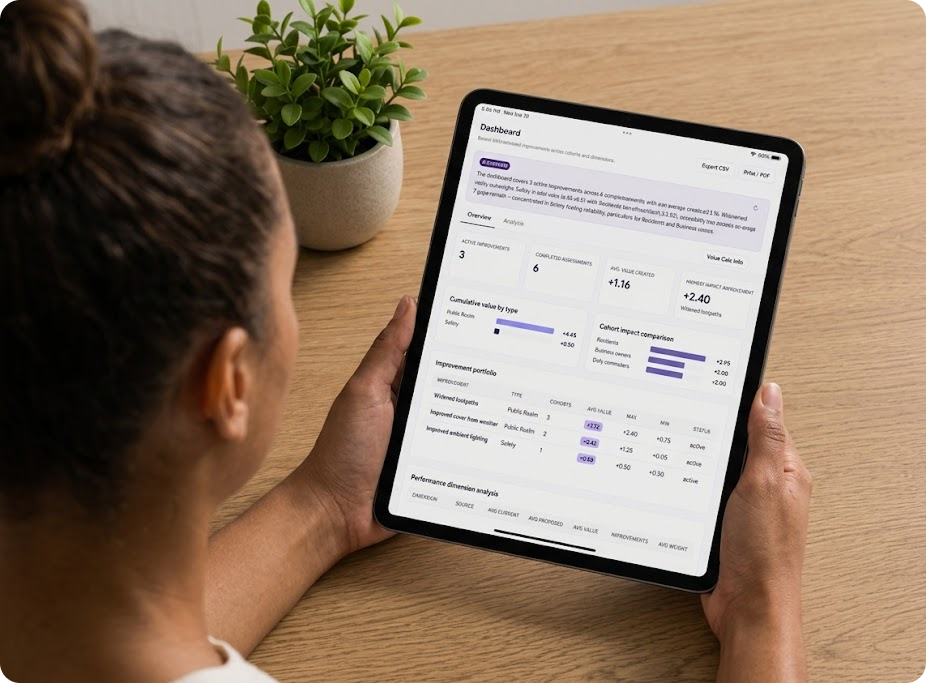
The Performance Framework is a structured scoring tool that makes improvement prioritisation explicit and defensible. It works by defining the performance dimensions that matter to a programme, assigning weights that reflect what different customer cohorts actually care about, and scoring how much any given improvement moves the dial. The result is a ranked view of where effort creates the most value, and a clear rationale for every decision made.
Get our Elemental CX whitepaper Discover why traditional CX measures only tell part of the story, and what it takes to influence the choices that drive acquisition and retention.